Country study
Italy: cities, states and the making of a nation
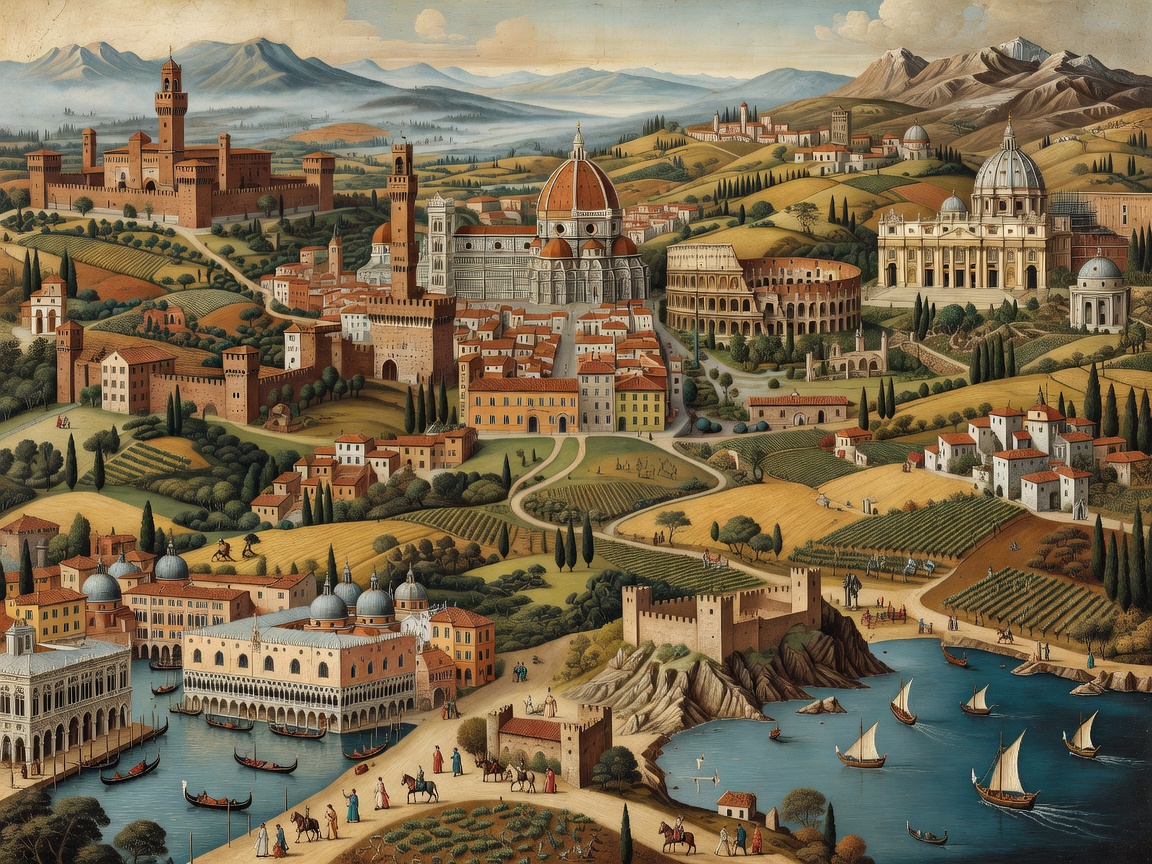
Italy’s historical importance predates the Italian state by centuries. Rome, the papacy, maritime republics, Renaissance courts and southern kingdoms created a peninsula of dense political variety.
Why does Rome dominate the story?
Roman institutions, law, roads and language gave the peninsula a shared historical reference, but Roman unity did not survive unchanged. After imperial authority in the west weakened, Ostrogothic rule, Byzantine power and Lombard kingdoms divided the peninsula. The papacy became both a religious institution and a territorial power.
This layered inheritance mattered later. Medieval rulers could invoke Roman legitimacy, while cities adapted Roman law to new commercial and communal settings. Italy was not simply waiting to become a nation; it was producing political forms that made unity both imaginable and difficult.
How did the medieval cities gain influence?
Communes such as Florence, Milan and Bologna developed institutions that allowed urban elites to govern, raise revenue and regulate trade. Venice and Genoa built maritime empires whose power rested on shipping, commerce and strategic ports. Their interests did not always align with inland lordships or the papacy.
Economic growth and political participation were uneven. Guilds, merchant families and civic offices shaped public life, while rural populations and marginalised groups had less power. City government could be innovative and oligarchic at the same time.
What was the Renaissance?
The Renaissance was a set of cultural and intellectual movements rooted in Italian cities and courts. Humanists studied classical texts, artists developed new approaches to perspective and patronage linked culture to political reputation. The movement was not a clean break from the Middle Ages: Christian institutions, classical learning and commercial wealth remained intertwined.
Printing helped ideas travel, while the Catholic Church and princely courts supported artistic and architectural projects. Cultural achievement should therefore be read alongside labour, taxation, diplomatic rivalry and the unequal distribution of wealth that sustained it.
Why did foreign powers matter?
The Italian Wars drew France, Spain and the Habsburgs into competition over the peninsula. Control of Milan, Naples and other territories connected Italian politics to wider European conflict. Spanish Habsburg influence became especially important in much of Italy, while Venice, the papal states and independent duchies retained distinct institutions.
Foreign rule did not end local politics. Municipal elites, courts and regional economies continued to shape daily administration. The result was a patchwork of sovereignty rather than a political vacuum.
How was Italy unified?
The Risorgimento combined diplomacy, war, popular mobilisation and constitutional politics. Piedmont-Sardinia supplied a monarchic framework; Giuseppe Garibaldi’s campaign transformed the southern balance; plebiscites and annexations expanded the kingdom. Rome joined the kingdom after the collapse of papal territorial power.
Unification created a state before it created a fully integrated society. Regional economies, languages, literacy, class relations and relations between church and state varied sharply. Later industrialisation, fascism, resistance and republican reconstruction continued the work of defining what Italian citizenship and national belonging meant.